

Mortgage Credit Transfer: how much can you save by switching banks?
Discover in this article what calculations to make before making a decision, the costs of switching banks, and how to save on life insurance with the transfer.Transferring the mortgage to another bank is worthwhile when the savings on the monthly payment and insurance cover the process costs in just a few months and make a difference over the entire loan. In 2026, many banks will cover part or all of these costs, especially for variable rate loans.
What is a mortgage transfer
Transferring the mortgage is, in practice, taking out a new loan from another bank and using that money to pay off the mortgage you have with your current bank in one go. The new bank pays the debt to the original bank and takes over the mortgage. From then on, you start paying the monthly payments to the new bank, under the terms of the new contract.
Renegotiate or transfer: what's the difference?
You can renegotiate or transfer the mortgage at any time, as long as the contract is active. But they are different things, while in renegotiation, the bank remains the same and the contract and its terms are changed, in a transfer you change banks. It's worth trying renegotiation first and only then comparing it with the conditions the market offers.
How much does it cost to transfer the mortgage
When transferring the mortgage, you pay off the entire debt to the old bank in one go. Therefore, you may have to pay an early repayment fee, which is, at most, 0.5% of the outstanding capital if the rate is variable and 2% if it is fixed.
There are banks that cover almost all the costs of the transfer when the mortgage is at a variable rate.
For fixed-rate mortgages, almost all banks cover the fee up to 0.5%, and the customer pays the remaining 1.5%.
Pay attention to the minimum amount: these campaigns usually require a minimum outstanding capital, and if yours is lower, you might be excluded. Campaigns change frequently, so check the conditions with the bank before deciding.
When is it worthwhile to transfer the mortgage
The practical rule is to divide the costs that the new bank doesn't cover by the monthly savings on the payment. The result is the number of months it takes to recover the money spent. Also, see how much you save in total, until the end of the loan, by adding up everything you will pay (compare the MTIC of the proposals).
Transfer costs ÷ Monthly savings = Number of months to recover the money
The calculation is only reliable if you compare the same scenario across all banks. Three precautions:
- Compare the TAEG and the MTIC, not just the spread. They include interest, fees, taxes, and insurance, and the lower they are, the lower the total cost of the loan.
- The lowest spread may depend on associated products (insurance, account, card). Add up the cost of these products.
- If there is little time left to finish the loan, or if the outstanding capital is low, the savings may not be enough to cover the costs, and the transfer may not be worthwhile.
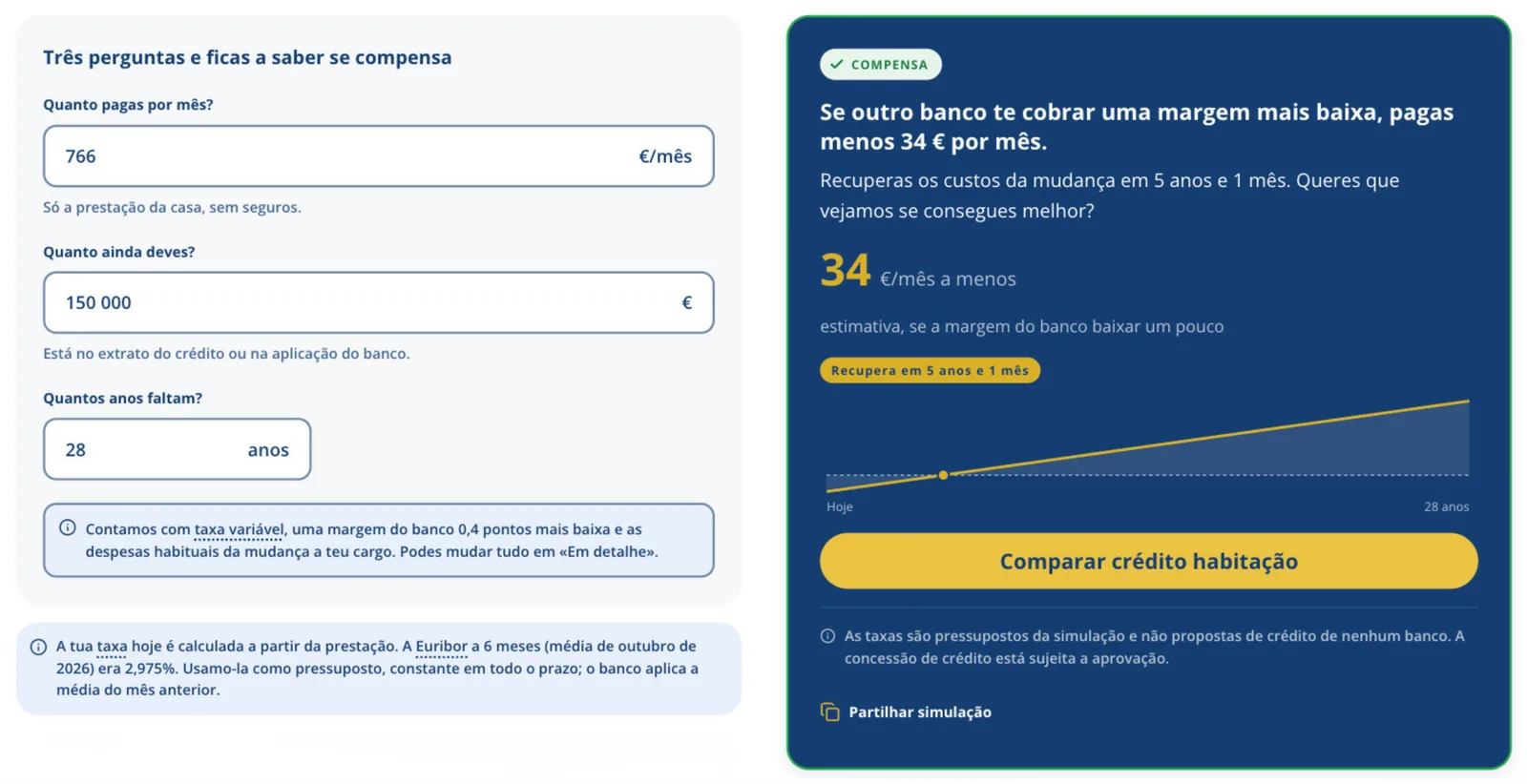
If you don't have proposals from other banks yet, you can start with a simpler calculation. In the CrediSegur mortgage transfer simulator, just enter your current monthly payment, the amount you still owe, and the years remaining to complete the loan. In minutes, you'll have an estimate of how much you could save per month.
How to save on life insurance when switching banks
When you switch banks, you have to change the life insurance anyway, because the new bank becomes the beneficiary. It's a good time to compare prices and coverage with other insurers.
The bank usually offers its own insurance (life and multi-risk) in exchange for a reduction in the spread, but it's not mandatory to take them out there. According to DECO PROteste, transferring the life insurance to an insurer outside the bank can save between 20% and 60% of the premium per year, with the same coverage that the bank requires. The amount may depend on your age, the outstanding capital, and your health history.
In practice, request simulations from one or more insurers, with the same capital and the same coverage, including the total price of the insurance until the end of the loan. If it pays off, take out the policy and submit it to the bank for approval. The bank cannot refuse insurance that meets the minimum requirements.
There's a catch: the bank may withdraw the spread discount it offered for having your insurance. So, do the math carefully. On one side, the payment with the bank's insurance and the discount; on the other, the payment without the discount plus what you'll pay to outside insurers. And look at the entire loan, not just the first year.
When comparing, don't just look at the price. Check if the insurance covers Death and Absolute and Permanent Disability (IAD), which is what most banks require, or if it also has additional coverage, such as Total and Permanent Disability (ITP) and diagnosis of serious illnesses. Also confirm from what degree of disability the insurance pays, what the exclusions are (pre-existing conditions, risky professions, sports), and how the premium increases with age.
Advantages of having a credit intermediary in the process
All this takes work, and this is where a credit intermediary can help you. They don't grant credit, but request proposals from several banks, help prepare the process, and can compare the bank's insurance with those from outside. Between paperwork, appraisal, notifying the old bank, insurance, and deed, having someone to handle everything prevents the process from stalling.
Before choosing a credit intermediary, confirm that they are listed with the Banco de Portugal and ask who pays them. In the case of CrediSegur, you can check our registration and the banks we work with in the customer information sheet.
Whether to buy a house, transfer, or renegotiate your mortgage, we are available to hear your case and help you find the conditions suitable for your situation.
Article by CrediSegur (CRRF – Brokerage, Lda.), a tied credit intermediary registered with Banco de Portugal under no. 0001290. We present proposals from the banks with whom we have a binding contract, identified in the Consumer Information, and we do not provide consulting services. Insurance agent registered with ASF under no. 421571530.